Nigeria Electricity Tariff Bands Explained: Why Your Neighbour Pays Less Per Unit Than You
Why does your electricity cost more than your neighbour's? Nigeria's Band A–E tariff system explained — what each band means, what you pay per kWh, and how to find out which band you're in.

You and your friend both recharged ₦5,000 electricity tokens in the same week. His lasted three weeks. Yours ran out in ten days. Same state. Same general area. Completely different results.
You're not imagining things. You're in different tariff bands.
---
What Is the Tariff Band System?
In 2026, the Nigerian Electricity Regulatory Commission (NERC) introduced a performance-based tariff system that divides electricity consumers into five bands: A through E.
The core logic is simple: the more hours of electricity supply your feeder line receives per day, the more you pay per unit (kWh). The less supply you get, the less you pay.
It sounds backwards — why should you pay more for a service that's actually working? But the economic reasoning is that Band A feeders require more investment to maintain high supply hours, and the tariff reflects the cost of delivering that service.
---
The Band Breakdown
| Band | Supply Hours Per Day | Tariff Rate (approx. 2026) |
|---|---|---|
| Band A | 20+ hours | ~₦225 per kWh |
| Band B | 16–20 hours | ~₦63 per kWh |
| Band C | 12–16 hours | ~₦50 per kWh |
| Band D | 8–12 hours | ~₦45 per kWh |
| Band E | Under 8 hours | ~₦40 per kWh |
This is why ₦5,000 of electricity lasts three weeks for a Band D customer and ten days for a Band A customer — even in the same city, buying from the same platform.
---
The Irony Nobody Talks About
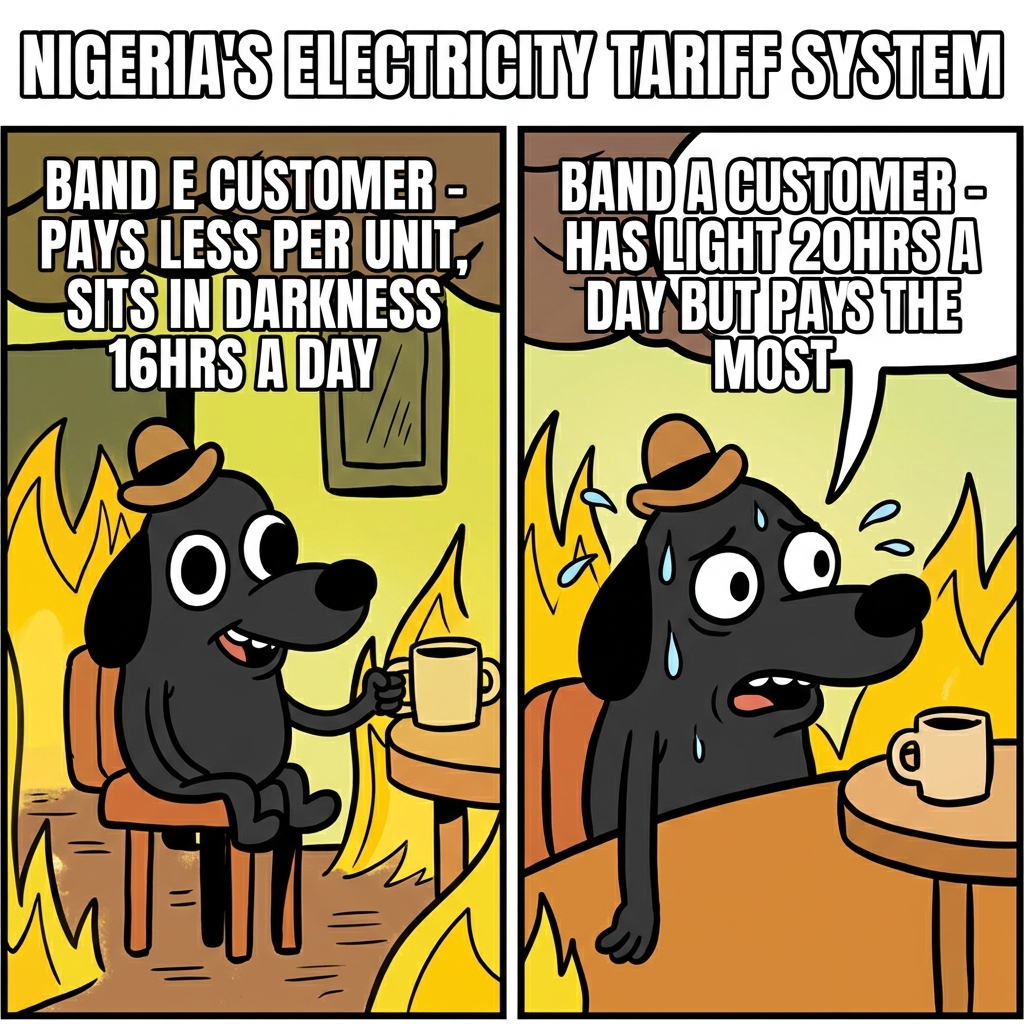
Band A customers pay the highest rate in Nigeria. They also receive the most electricity. They are essentially funding the grid improvements that make their own supply reliable — while lower-band customers pay less but deal with frequent outages.
This creates a situation where the Nigerians who can afford to live on Band A feeders (typically higher-income areas, GRAs, new estates) benefit most from the tariff reform. Those in Band E areas (often lower-income communities) pay less per unit but live with the worst supply.
NERC's position is that investment follows tariff — if the revenue isn't there, the infrastructure improvement doesn't happen. Whether that argument holds in practice is a conversation Nigerians have been having loudly on social media since the policy launched.
---
How to Find Out Which Band You're In
Method 1: Check your prepaid meter.
On many modern meters, your tariff band or tariff class is displayed in the meter's information screen. Scroll through the meter menu (usually by pressing the blue button) until you see "Tariff Index" or "Tariff Class."
Method 2: Call your DISCO.
Every distribution company has a customer care line. Tell them your meter number and ask which band you're on.
Major DISCOs and contact lines:
Method 3: NERC tariff portal.
The NERC website (nerc.gov.ng) has a tariff lookup where you can check rates by DISCO and band.
---
Why the Same Neighbourhood Can Have Different Bands
This is the part that confuses most people. Your tariff band isn't determined by your street, your local government area, or even your estate name. It's determined by your transformer feeder line.
Two houses 200 meters apart — one connected to Feeder A running 20 hours, one connected to Feeder B running 10 hours — will be in different bands and pay different rates. This is why your friend in the same estate sometimes pays less per unit than you do.
The feeder line that serves your transformer is the key unit of the band classification.
---
How to Dispute Your Band Classification
If you're paying Band A rates but genuinely receiving Band D levels of supply, you have grounds to dispute.
Step 1: Document your outages. Keep a log of hours without power for at least two weeks, including timestamps.
Step 2: Contact your DISCO's customer care and formally request a band review with your documentation.
Step 3: If your DISCO doesn't respond or dismisses your complaint, escalate to NERC.
NERC complaint channels:
NERC has the authority to audit feeder performance and reclassify bands. It's a slow process, but it works.
---
Why Electricity Is Getting More Expensive
Nigeria removed the electricity cross-subsidy that previously kept lower-band tariffs artificially low. The government's position is that subsidies were unsustainable and were being poorly targeted — money meant to help the poor was going to a system that didn't reliably deliver power to anyone.
The tariff reform aims to make the electricity sector commercially viable so that private investment can flow in, infrastructure improves, and supply hours increase over time.
Whether that logic plays out in practice, every Nigerian is watching.
---
However Much You're Paying Per Unit — Buy Your Token Without the Queue
Whatever band you're on, you don't need to queue at a bank or NERC office to recharge your prepaid meter.
On Vtyield, you enter your meter number, the platform confirms the meter account name before you pay, you enter the amount, and your token arrives instantly — delivered directly to your registered phone number and email. Works for all DISCOs, all bands, 24 hours a day.
No agent fee. No queue. The exact token you need, in under a minute.
Get more like this — free
No spam. Just useful Nigerian fintech tips, once a week.
You might also like
How to Fix Prepaid Meter Token Rejections (E16, KCT & More)
Meter rejecting your token? Here is exactly how to fix KCT errors, E16 errors, and debt-related token rejections in Nigeria.
How to Get a Prepaid Meter in Nigeria (2026)
Stop fighting with your DISCO over estimated billing and follow this simple guide to getting a prepaid meter in Nigeria today.
Buy Ikeja Electric Token Online: Fast IKEDC Prepaid Recharge
Discover how to buy your Ikeja Electric token online quickly, understand your tariff bands, and resolve meter rejection issues.
Ready to try it out?
Airtime, cheap data, electricity tokens, cable TV — delivered in seconds. No queues, no agents.
Account saves your history & earns you referral bonuses