

How to Build Your Own VTU Website in Nigeria Without Writing Code (2026 Guide)
You don't need to know JavaScript, Python, or any programming language to launch a VTU business with your own branded website. Here's exactly how white-label platforms work and what it actually costs.

Every week, someone in a Nigerian tech group asks: "How do I build my own VTU website?"
And every week, the answers are the same: "Learn PHP," "Use WordPress + a VTU plugin," "Hire a developer for N200,000."
All of those answers are wrong in 2026. Not because they don't work — they do, technically. But they're solving the wrong problem.
You don't need to build a VTU website. You need to launch a VTU business. Those are different things, and confusing them is why most people never get started.
The Old Way vs. The New Way
The Old Way: Build From Scratch
The New Way: White-Label Platform
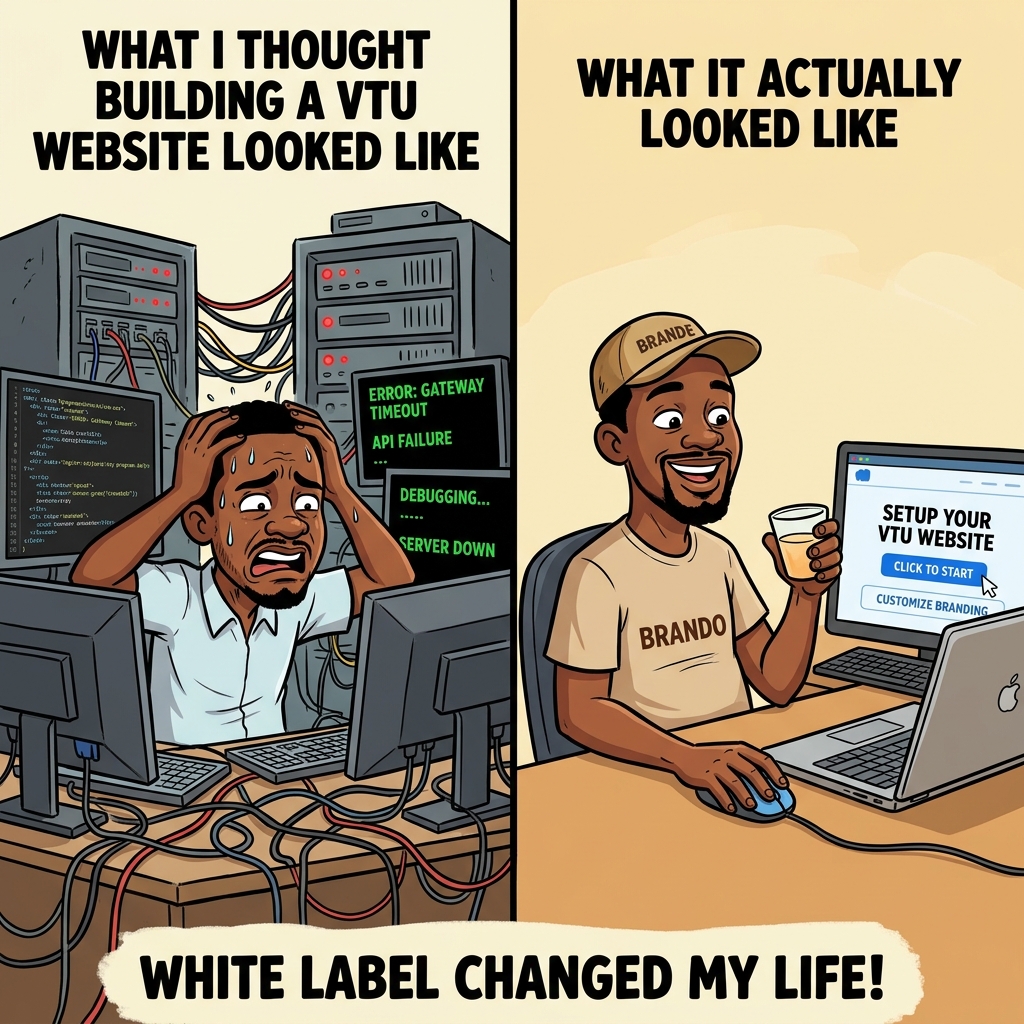
Same result. Different century.
What Exactly Is a White-Label VTU Platform?
Think of it like this: you walk into a restaurant kitchen. The chef, the equipment, the recipes, the ingredients — everything is already there. You just put your own restaurant name on the door and set your own menu prices.
A white-label VTU platform gives you:
You're not building anything. You're configuring a business.
The Real Economics: How White-Label VTU Makes Money
Here's the part nobody talks about honestly. Let me show you real numbers.
Your cost (wholesale price you pay):
What you charge your customers:
Monthly revenue math for a small operation:
If you process 50 transactions per day (very achievable with a good website + WhatsApp marketing):
| Service | Daily Volume | Avg Profit/Transaction | Daily Profit |
|---|---|---|---|
| Data | 30 sales | N50 | N1,500 |
| Airtime | 10 sales | N15 | N150 |
| Cable TV | 5 sales | N200 | N1,000 |
| Electricity | 5 sales | N100 | N500 |
| Total | 50 | N3,150/day |
By month 6, if you've grown to 150 transactions/day (common for active resellers), you're making N280,000+/month.
Step-by-Step: Launching Your VTU Website
Step 1: Choose Your White-Label Provider
Not all white-label VTU platforms are equal. Here's what to look for:
Full disclosure: Vtyield offers white-label portals. We built it because enough resellers asked for it. You get your own branded domain, your own pricing, your own customer base — we handle the infrastructure.
Step 2: Register Your Domain
Your domain is your identity. A few tips:
Step 3: Set Up Your Branding
You need three things:
1. A logo — use Canva (free) or hire someone on Fiverr for N5,000
2. Your brand colors — pick 2-3 colors that feel professional. Green + dark blue = trust. Orange + black = energy.
3. Your tagline — something short: "Top up in seconds" or "Your data plug" or "Bills made easy"
Step 4: Configure Your Pricing
This is where most new resellers mess up. Here are the rules:
Don't undercut everyone. If the market price for MTN 1GB is N280-N320, don't sell at N250 thinking you'll win on volume. You won't — you'll just go broke faster.
Don't overprice. If everyone sells at N300 and you're at N400, nobody cares about your pretty website.
The sweet spot: price yourself at the median market rate or slightly below. Win on speed and reliability, not price.
Step 5: Set Up Your Payment Channels
Most white-label platforms come with payment processing built in. But you should also set up:
Step 6: Launch and Market
Your website is live. Now you need customers. Here's what actually works in Nigeria:
WhatsApp Status marketing — post your prices on your WhatsApp status 2-3 times daily. This is still the #1 acquisition channel for VTU resellers in Nigeria.
Create a WhatsApp group — "Data & Airtime Deals" with your friends, family, church members, school mates. Post exclusive deals weekly.
Instagram/TikTok — short videos showing how fast transactions complete on your platform. Speed sells.
Referral program — give existing customers N50 credit for every new customer they bring. Word of mouth is king in Nigeria.
Local marketing — print simple flyers for your area. "Buy cheap data, airtime, pay bills at [your website]. Instant delivery."
Common Mistakes to Avoid
1. Trying to compete with the networks directly. You're not MTN. Don't market like them. You're the neighborhood guy who delivers faster and cheaper. Own that positioning.
2. Ignoring customer support. The first time someone's transaction fails and you don't respond for 3 hours, you've lost them forever. Set up a WhatsApp Business account and respond within 30 minutes.
3. Not tracking your margins. Use a simple spreadsheet. Know exactly how much you're making on each product daily. If a product has negative margin, stop selling it immediately.
4. Growing too fast before systems are ready. Don't run Facebook ads in week one. Get your first 50 regular customers organically. Iron out the kinks. Then scale.
Is It Actually Worth It in 2026?
Yes. The VTU market in Nigeria is estimated at over N4 trillion annually and growing. More Nigerians are coming online every month. Data consumption is up 40% year-over-year. And the big networks still don't have great digital experiences — there's a gap for fast, reliable, fairly-priced resellers.
The barrier to entry has never been lower. You don't need coding skills. You don't need N500,000. You don't even need an office.
You need a white-label platform, a domain name, and the willingness to treat it like a real business.
Ready to launch? Check out Vtyield's white-label portal options or start selling as a guest reseller with zero setup cost.
Get more like this — free
No spam. Just useful Nigerian fintech tips, once a week.
You might also like
Vtyield Agent & Reseller Hub: Build Your VTU Business
Join the Vtyield Agent network. Get access to wholesale prices, API integrations, and start your own profitable VTU business today.
How to Start a Profitable VTU Business in Nigeria (2026 Guide)
Learn the exact steps to launch a VTU business in Nigeria, understand the profit margins, and handle everyday challenges like network downtime.
How to Start a VTU Reseller Website in Nigeria: The Complete 2026 Guide (With Real Numbers)
Thinking about starting a VTU business or white-label data reselling website in Nigeria? This guide covers startup costs, profit margins, what platforms to use, and the exact steps to go from zero to your first 100 customers — with real numbers, not hype.
Ready to try it out?
Airtime, cheap data, electricity tokens, cable TV — delivered in seconds. No queues, no agents.
Account saves your history & earns you referral bonuses